 Gabri
A free HWID spoofer is a hardware ID spoofer you do not pay for: an open-source project, a cracked or leaked copy of a paid tool, or a "free" loader handed out on a download page. Most of its risk sits in the file you run. From April 1, 2024 to March 31, 2025, Kaspersky counted more than 19 million attempts to download malicious or unwanted files disguised as popular Gen Z games, with cheats, mods, cracks and fake installers among the lures, and more than 400,000 users were affected.
On November 9, 2026, I read what Kaspersky, Trend Micro, Microsoft and Epic Games have published on this, and I checked the top 10 Google results for "free hwid spoofer". Two were "download free" pages on domains with nothing to do with gaming, and most of the rest were videos, a podcast episode and forum posts.
If a game has already banned your PC and you want the alternative to a free download, skip to the free trial section. If your ban is on the account only, or you have not been banned at all, Saturn is not your answer, and the next section explains why.
Do You Need an HWID Spoofer at All?
An HWID spoofer helps with one kind of ban only: a ban on your hardware. A hardware ID ban is saved against serial numbers from your PC, such as the motherboard, the disks and the network card, so a new account on the same machine gets caught again. An account ban is saved against the account, and no spoofer, free or paid, changes that.
So start with the ban notice. If it names the account only, the publisher's appeal process is the real fix, and you do not need any spoofer. If you have not been banned at all, you do not need one either, because running kernel-level software you have no use for is all risk and no reward.
Appeal first, spoof second.
What Is a Free HWID Spoofer?
A free HWID spoofer is software that changes the hardware identifiers a game's anti-cheat reads from your PC, offered at no cost. The job is the same as a paid tool's: intercept the identifiers a game reads and return different ones, which is what an HWID spoofer does whatever it costs. What changes is where the free version comes from, and that decides most of the risk. (A "free spoofer" for Pokemon GO location is a different tool, and this page does not cover it.)
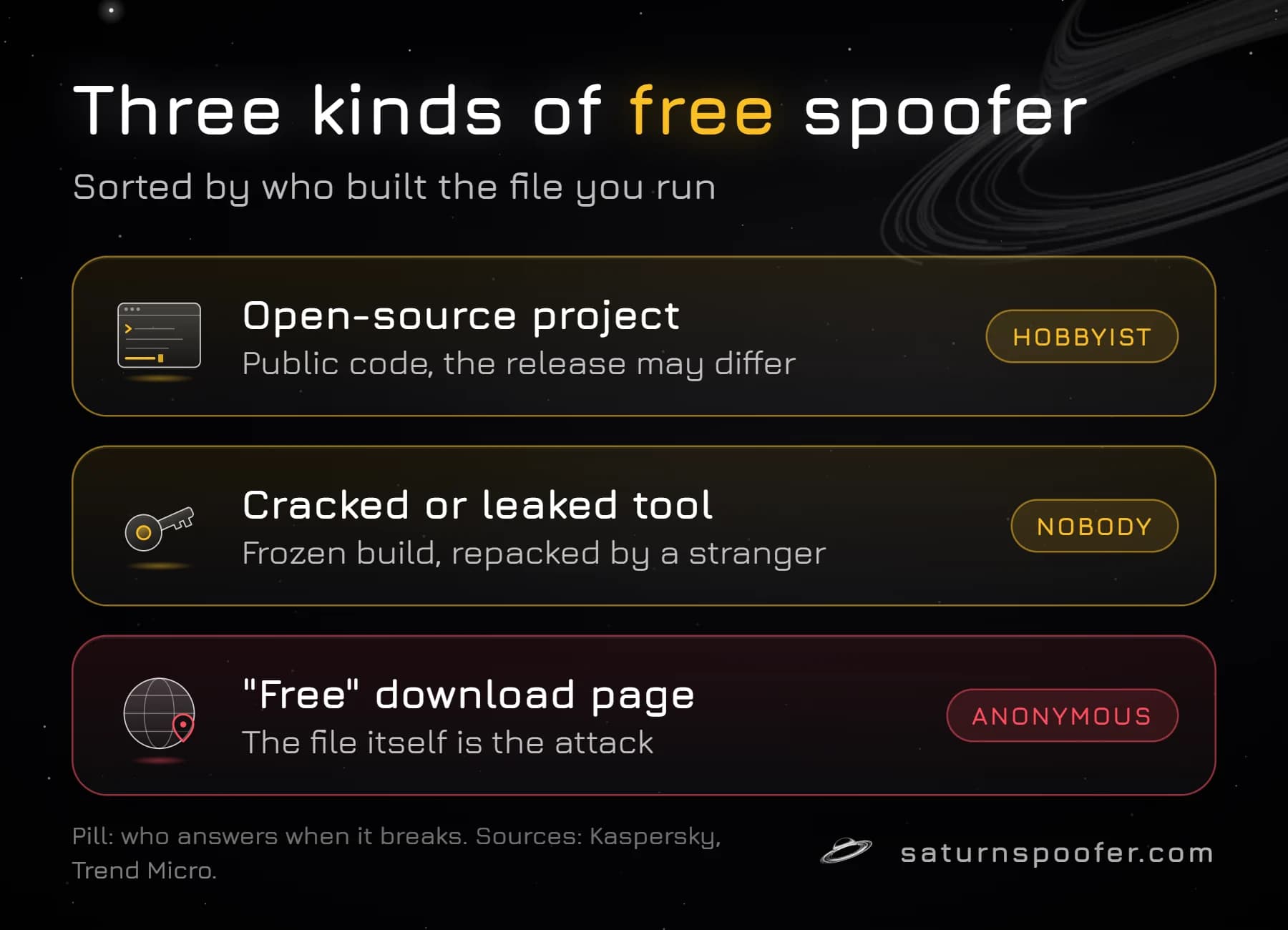
Free spoofers come in three kinds. I sorted them by who built the file you end up running, because every risk below comes back to that.
| Kind | Where it comes from | Who answers when it breaks | Main risk |
|---|---|---|---|
| Open-source project | A public code repository | A hobby maintainer, if still active | Public code, and a release file that may not match it |
| Cracked or leaked paid tool | Forums, file hosts, chat servers | Nobody | A frozen build, repackaged by a stranger |
| "Free" loader or download page | Download sites, video descriptions, ads | An anonymous uploader | The file itself is the attack |
Some sellers also give a tool away free or offer a free trial, which is a fourth case and a different deal: a seller you can identify, with limits written down. The five tests further down apply to them like anyone else.
Are Free HWID Spoofers Safe?
Most free HWID spoofers are not safe, and the bigger danger is malware that rides in with the download, not the ban. Kaspersky and Trend Micro both documented the same pattern in 2025: attackers name a file after something gamers search for, such as a cheat, a mod or a crack, and put a stealer inside.
The clearest recent case is Stealka. In a post dated December 18, 2025, Kaspersky described the Stealka infostealer, which its researchers found in November 2025 and which most often disguises itself as game cracks, cheats and mods. Kaspersky says it spreads through GitHub, SourceForge, Softpedia and sites.google.com, and that it starts only when the user runs the file.
What Stealka takes is the part that matters. Kaspersky lists data from over 100 browsers, including saved passwords, cookies and session tokens, plus the settings of 115 browser extensions for crypto wallets, password managers and 2FA, 80 wallet applications, and the files of messaging apps such as Discord and Telegram. Steam and other game launchers are on the list too, and Kaspersky notes that stolen session tokens can let an attacker get past two-factor authentication without the password.
In my reading, a spoofer is close to the ideal wrapper for this. A real one needs administrator rights and deep system access to do its job, so a fake one gets the same permissions without raising an eyebrow.
The ban you were trying to fix is the smaller loss. A stolen Steam, Discord or email session costs more than any game.
Are HWID Spoofers on GitHub Safe?
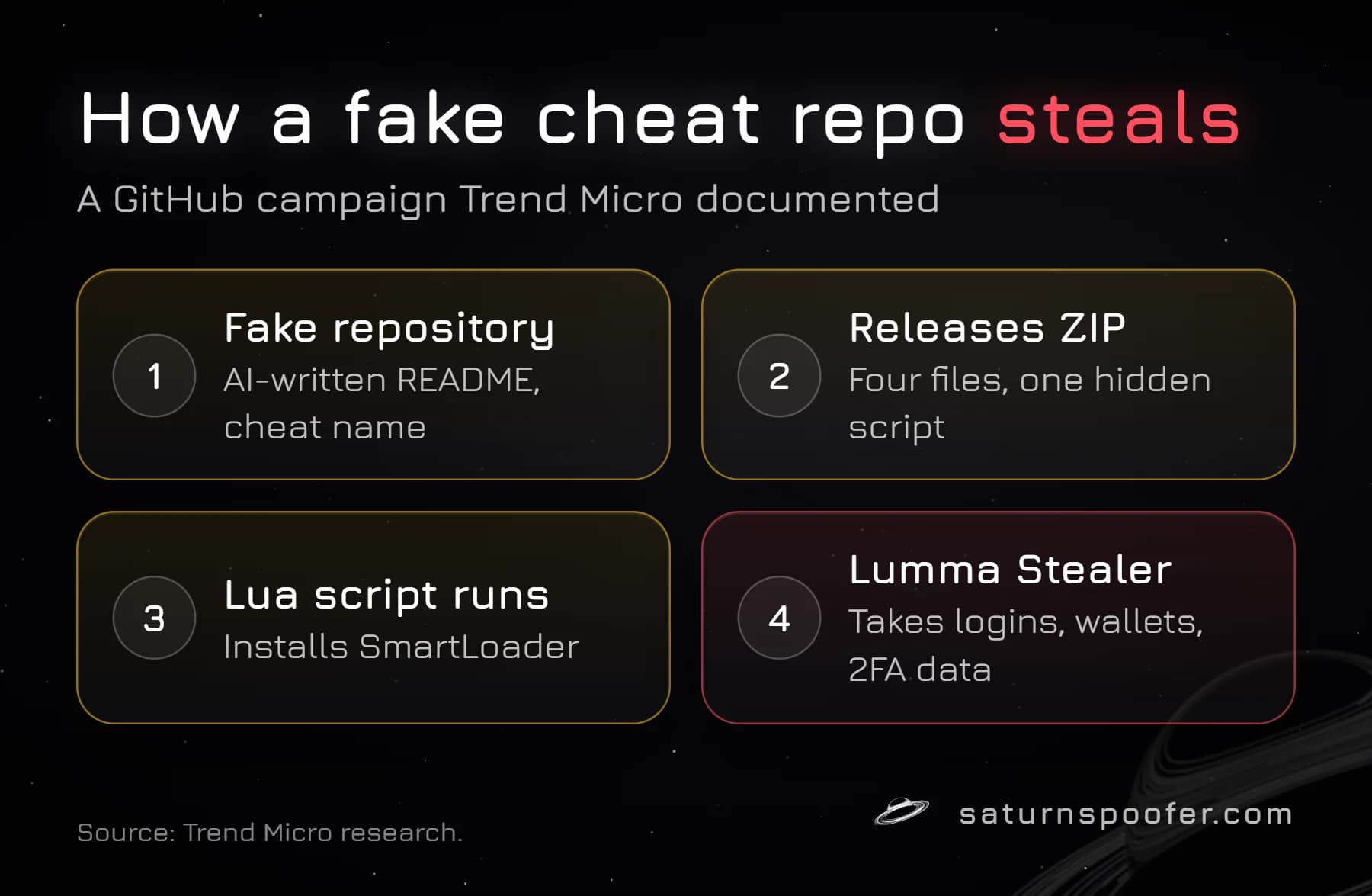
An HWID spoofer on GitHub is only as safe as the file you download, and that file is often not the code you can read. In a report dated March 11, 2025, Trend Micro documented fake GitHub repositories that posed as game cheats, cracked software and crypto tools, with the real payload hidden in the Releases section.
Trend Micro found that the README files in those repositories looked heavily AI-written, with excessive emoji and polished structure. The download was a ZIP with 4 files: a Lua runtime, a loader, a batch file and an obfuscated Lua script, and only the script was malicious. It installed SmartLoader, which then delivered Lumma Stealer, a stealer its makers rent out as a service.
The lesson reaches past that one campaign. A public repository lets anyone read the code, but most people download a compiled release, and nothing forces the release to match the code. Reading the source protects you only if you build it yourself, and few people looking for a free spoofer are going to compile a kernel driver. That last part is my inference, not a Trend Micro finding.
A genuine open-source spoofer has a second problem - the anti-cheat teams can read it too.
Free "Download" Pages and the Fake Virus Scan
A page offering a free HWID spoofer download is the most direct version of the risk, because the page exists to get a file onto your PC. The 2 that ranked in the top 10 for "free hwid spoofer" on November 9, 2026 sat on unrelated domains with an Ahrefs Domain Rating of 0 and 2. I did not open either one.
Kaspersky's Stealka research shows how these pages earn your trust. The attackers built fake sites that look professional, used popular search terms in the page title and file name as bait, and showed a banner claiming the file was being scanned by a dozen antivirus engines. No scan took place, and the file inside was the same stealer whatever the page advertised.
Kaspersky's own advice for gamers is to download games, mods and tools only from official sources. A free spoofer on a download page has no official source to check against.
Cracked and Leaked Paid Spoofers
A cracked or leaked copy of a paid HWID spoofer looks like the best deal of the three, because it is a real product with the payment removed. In my view it is usually the worst. No license server. No updates. No one to email when it breaks. A cracked build stays frozen at the version that leaked, so the first anti-cheat update after the leak can leave it behind for good.
The bigger issue is who touched the file last. Whoever cracked it had to modify it, and running it means trusting that person with a kernel driver. Kaspersky's Stealka report names cracks as one of the stealer's favorite disguises, and Trend Micro's GitHub campaign used cracked software as a lure too.
A cracked spoofer carries the paid tool's footprint and none of its maintenance.
The Kernel Driver Problem
Spoofers aimed at modern anti-cheats often work at kernel level, the deepest layer of Windows, because the anti-cheats they face run there too, which is what kernel-level anti-cheat means. Microsoft's driver documentation, last updated October 29, 2025, explains why that layer is risky. An ordinary application runs in user mode with its own private memory, so when it crashes, nothing else goes with it. All kernel-mode code shares one address space, so a kernel driver that writes to the wrong place can corrupt Windows itself, and one that crashes takes the whole operating system down.
That is true of every kernel driver, paid or free, Saturn's included. The difference is what happens next. A seller has a reason to fix a crash, because customers leave. A free driver from an anonymous upload has nobody behind it, and if a spoofing tool leaves deep changes behind, Epic's support advice is that you may need to reinstall your operating system to remove its effects.
Any spoofer that works at that level needs kernel access - so choose who you hand it to.
Do Free HWID Spoofers Work?
Free HWID spoofers can work for a while, but in my reading they tend to stop at the worst moment: right after an anti-cheat update, with nobody shipping a fix. And publishers say openly that they look for these tools. Epic's support page on the Hardware Identifiers Warning, which I read on November 9, 2026, says the warning means Epic has detected "a tool that hides or changes your computer's hardware identifiers", and that a player who does not remove it may be removed from matches, or have the Fortnite account permanently banned. That rule covers every spoofer Epic catches, free or paid. Epic's own phrase, "often used to avoid a hardware ban", also confirms it bans hardware, which is what a Fortnite HWID ban is.
Free tools carry three extra handicaps. These are my reading of how the three kinds work, not something a publisher has written down:
- Public code is public to everyone. An open-source spoofer's code is as readable for an anti-cheat team as it is for you, which makes it an easy thing to recognize.
- Nobody is paid to update it. When an anti-cheat changes what it reads, a hobby project or a cracked build stays where it was.
- Free tools are often temporary-only. Many mask identifiers only while they run, so your real, banned IDs return the moment they close, which is the line between permanent and temporary spoofers.
A free spoofer that worked last month tells you nothing about tonight.
How to Judge Any HWID Spoofer, Free or Paid
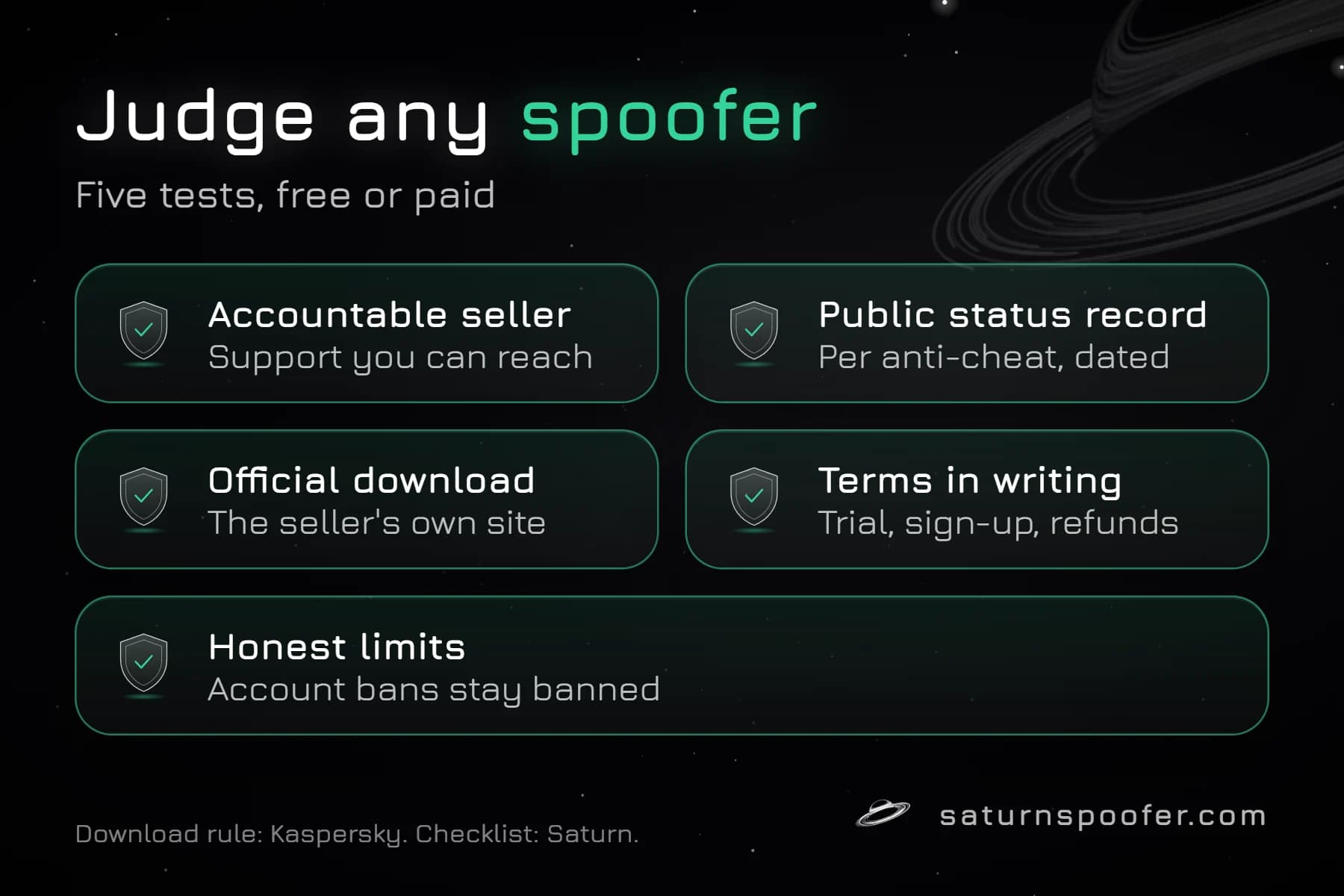
An HWID spoofer is worth trusting only if someone accountable stands behind it, and you can check that before you run anything. These are the 5 tests I would put to any spoofer, Saturn included:
- An accountable seller. A named business with a support channel you can reach, not an anonymous upload.
- A public status record. A page that shows, per anti-cheat, whether the tool works after each update, with dates.
- An official download. The file comes from the seller's own site or a link on its own pages, not a reupload or mirror posted by someone else. Kaspersky and Trend Micro both found stealers on trusted platforms, so "it was on GitHub" proves nothing.
- Terms in writing. Trial length, what the trial covers, what you need to sign up, and the refund policy, all on pages you can read before you pay.
- Honest limits. A straight seller tells you an account ban stays banned. A tool that promises you can never be banned again fails this test.
A free open-source project can pass part of this, and a few are run by people who answer bug reports. A leaked build or an anonymous download page fails nearly every line.
Where a Free Trial Fits Instead
A free trial is the honest version of "free": a seller you can identify lets you run the real product for a fixed time, then asks you to pay. That is the deal we offer with Saturn, and it is why Saturn comes up on this page.
Saturn is an HWID spoofer, not a cheat, and it runs on Windows. It ships as one loader, and your license decides which anti-cheats it covers: Riot Vanguard, Easy Anti-Cheat, BattlEye (with FiveM inside), EA Javelin and Anti-Cheat Expert, 5 licenses in all. The HWID spoofer free trial runs for 24 hours, needs no card, and does need an email so we can send the key. It covers every Saturn product, so you can check your own game before you pay anything.
Saturn comes in two modes. Temporary gives you unlimited hardware profiles, and your original IDs come back when you stop using it. Permanent gives you one profile. The live status page lists each anti-cheat separately, and the screenshots on our Saturn reviews page show what users have posted about it.
Where Saturn falls short: it is free for 24 hours, then it is paid. It needs an email. It runs at kernel level, so Microsoft's point about kernel drivers applies to it as much as to any free tool, and what we can offer against that is a team that answers. It does nothing for an account ban, it does not hide a cheat, and an anti-cheat that catches a cheat still bans the account.
Test the real product for a day before you trust anything with your kernel.
Pick One in 60 Seconds
| Your situation | Best move | Where it falls short |
|---|---|---|
| Account ban only, appeal open | Appeal through the publisher | Slow, and the answer can be no |
| Not banned at all | No spoofer | None, there is nothing to fix |
| Hardware ban, offered a cracked build or a "free download" | Skip it | You stay banned until you pick another option |
| Hardware ban, set on free and willing to accept the risk | Only an open-source project you build yourself | Public code, no updates, needs real skill |
| Hardware ban, want to test before paying | A paid spoofer's free trial (Saturn: 24 hours, no card, email required) | Paid after the trial, kernel-level like the rest |
| Hardware ban, want no spoofing software at all | Replace the flagged parts | Costs more, and you have to know which parts were flagged |
Free HWID Spoofer FAQ
Are free HWID spoofers safe?
Most free HWID spoofers are not safe. Kaspersky and Trend Micro have both documented stealers disguised as game cheats and cracks on GitHub and other trusted platforms, and a spoofer asks for exactly the deep access that malware wants. The risk is lowest with an open-source project you build yourself and highest with a cracked build or a download page.
Do free HWID spoofers work?
Some free HWID spoofers work for a while. In my reading they tend to stop after an anti-cheat update because nobody is paid to fix them, and Epic says it detects tools that hide or change hardware identifiers and may permanently ban the account.
Are HWID spoofers on GitHub safe?
An HWID spoofer on GitHub is not safe by default. In March 2025, Trend Micro found fake GitHub repositories, posing as game cheats, that hid a loader for Lumma Stealer in the Releases section behind an AI-written README. The readable code on the page tells you nothing about the compiled file you download.
Is it safe to download an HWID spoofer?
Downloading an HWID spoofer is only as safe as the source. In December 2025, Kaspersky described fake download sites that showed made-up antivirus scan banners, so download only from the seller's own site, and treat any "free download" page as hostile.
Can a free HWID spoofer get you banned again?
Yes, a free HWID spoofer can get you banned again. If the anti-cheat recognizes the spoofer, the new account can be banned, and Epic's own warning says the Fortnite account may be permanently banned. A temporary-only tool also brings your original, banned IDs back the moment it closes.
What is the difference between a free spoofer and a free trial?
A free spoofer from a repository, a crack or a download page has no accountable seller behind it, while a free trial is a paid product you can run for a fixed time. Saturn's trial lasts 24 hours, needs no card and requires an email, and it covers every Saturn product.
HOW I CHECKED THIS On November 9, 2026, I read Kaspersky's Stealka post (December 18, 2025) and its press release on games used as bait (June 9, 2025), Trend Micro's report on fake GitHub repositories (March 11, 2025), Microsoft's page on user mode and kernel mode, Epic Games' Hardware Identifiers Warning page, and Saturn's own homepage and status page. I checked the top 10 Google results for "free hwid spoofer" in Ahrefs the same day. I did not download, open or run any spoofer, and I did not visit the download pages. UNVERIFIED: whether any particular free spoofer contains malware. I did not test one, so this page names none.