 Gabri
Rust cheats are third-party programs, scripts or devices that give one player an edge Facepunch Studios doesn't allow in its survival game: an aimbot that aims for you, ESP that shows players and stashes through walls, or a recoil script that keeps a spray on target.
They're also why Rust bans so many accounts. Facepunch applied more than 296,000 permanent bans in 2025 alone, received over 16 million cheat reports in the same year, and has permanently banned more than one million accounts since 2013.
I read Facepunch's support articles, its devblogs and Rust's Steam page on November 9, 2026. This page covers the 5 kinds of Rust cheats and hacks, the anti-cheat layers that catch them, what a cheating ban takes from you, and the one situation an HWID spoofer fits.
If you waited out an old ban and a clean new account still got banned on the same PC, skip to the HWID spoofer section. If you're here to understand the cheaters raiding your base, Saturn isn't your answer, so read straight through.
What Are Rust Cheats?
Rust cheats are tools that read what the Rust client knows, or fake what your hands do, so one player sees, aims or sprays better than the game allows.
In Rust, that edge costs other people more than a round. Facepunch put it plainly in November 2026: when you die you can lose hours of progress, and when you're raided you can lose days or weeks of it, so a cheater who finds your base doesn't take one kill, they take the wipe.
In the same devblog, Facepunch reminded players that it has a "no tolerance policy for 3rd party software that offers an unfair advantage," and that covers paid cheats, free cheats and scripts alike.
In Rust, "cheats" can also mean admin console commands, which only work for an admin on their own server. Those are server tools, not cheating, and they aren't what Facepunch's anti-cheat is about. This page isn't about the Rust programming language either.
Cheats and hacks are the same thing here. People search "Rust cheats" about 2.5 times as often as "Rust hacks," for the same tools.
Types of Rust Cheats and Hacks
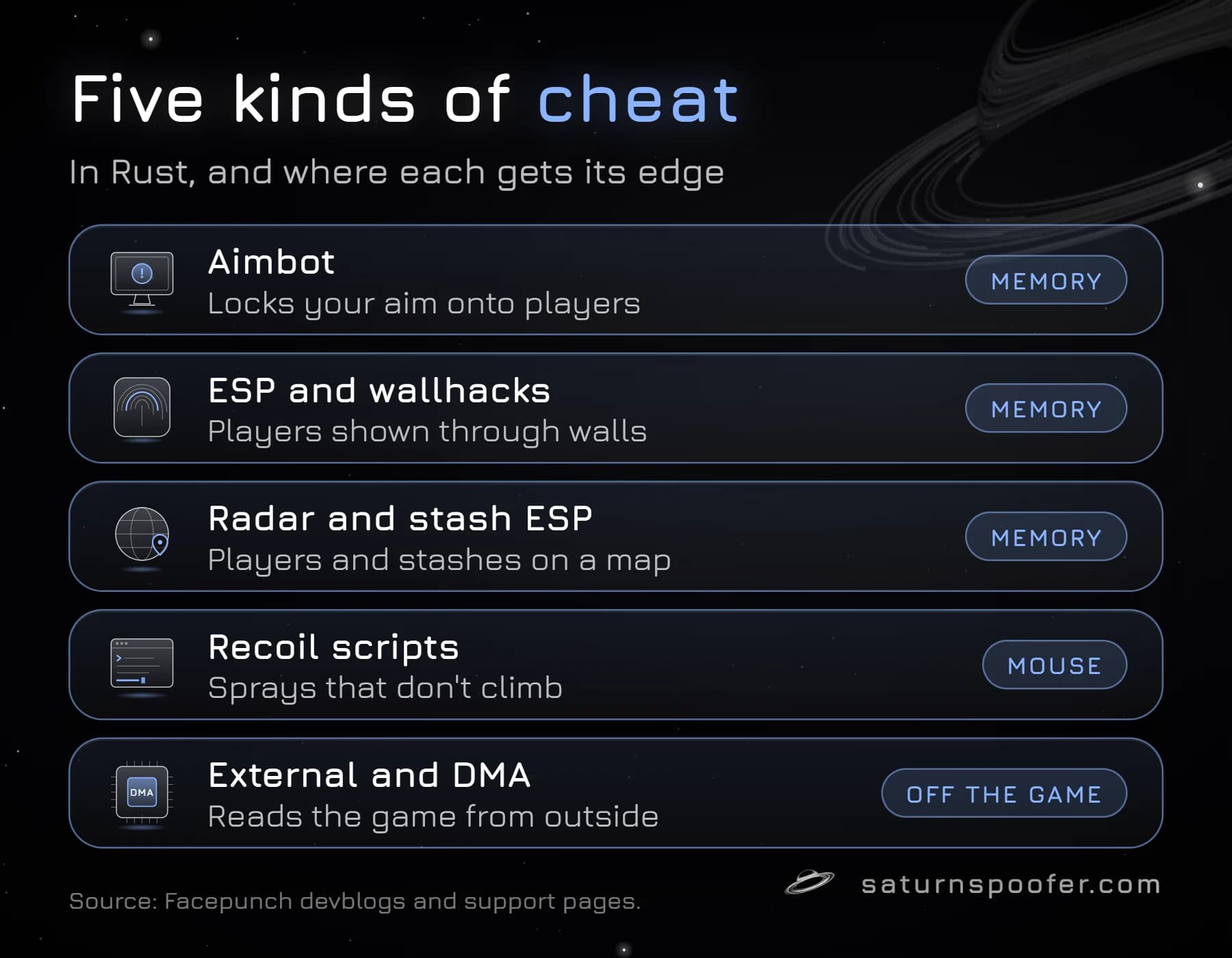
Rust cheats fall into five types, and the split I'd look at first is what Facepunch has publicly said it does about each one.
| Type | What it gives | What Facepunch targets |
|---|---|---|
| Aimbot | Aim that snaps onto players | Server culling, EAC |
| ESP and wallhacks | Players through walls | Server culling |
| Radar and stash ESP | Players and stashes on a map | Stash data cut |
| Recoil scripts | Sprays that don't climb | EAC scripting bans |
| External and DMA | A cheat off the game process | Nothing specific published |
Rust Aimbot
A Rust aimbot finds other players in the game's memory and moves your crosshair onto them, so the cheat does the aiming and you pull the trigger.
Facepunch's answer starts on its servers: since May 2025, server-side player culling has been on by default across all Rust servers, which means the server stops sending a player's position while terrain or rocks fully hide them, and Facepunch says that prevents or significantly limits both ESP and aimbot.
A cheat can't lock onto a player the PC was never told about.
Rust ESP and Wallhacks
Rust ESP draws other players through walls and terrain, usually as boxes with names, distance and the weapon in their hands.
ESP in games works on one principle: it reads positions the client already holds and paints them over the screen, so it never touches your aim. In Rust, that's exactly the data culling holds back. Facepunch said in March 2025 that the system mainly hinders players using wallhacks, and it called culling "only one piece of the puzzle," if a big one.
Rust itself ships an admin ESP for server staff and for spectating at events. On a player's PC, the same idea is a cheat.
Radar and Stash ESP
A radar puts every player on a mini-map you were never meant to have, and stash ESP marks buried stashes, loot and bases worth raiding.
In a game about hiding what you own, I'd argue stash ESP does more damage than an aimbot, and Facepunch went after the data behind it. In 2024, Facepunch said it had cut what cheaters can read from network data, including players' health, buried stash locations and the authorization lists on turrets and tool cupboards.
Server owners fight back as well. Facepunch's rules for community servers allow admin plugins that help with anti-cheat work or "troll (annoy) cheat users," including Admin Radar and Stash Traps, bait stashes set for players who shouldn't know they exist.
Recoil Scripts and Macros
A Rust recoil script pulls your mouse against the weapon's kick while you hold fire, so a spray that should climb stays on the target. Facepunch and Easy Anti-Cheat call it scripting.
Some scripts run as a program on the PC, and others run through macro software or a device between the mouse and the computer, but every version moves the mouse so your hand doesn't have to.
Facepunch admits this one is hard, and in November 2026 it wrote that scripting "has been a long-standing issue in Rust," that detection and enforcement can be difficult, and that it severely disrupts gunfights.
Easy Anti-Cheat began work aimed at "recoil cheats, often referred to as scripting" in mid-2025, and as the November 2026 wipe began, Facepunch said it was rolling out bans to users of public and private script providers, more than 3,000 accounts.
So scripts aren't a safe middle ground. Facepunch treats them as cheating, and a cheating ban from Easy Anti-Cheat on Rust is permanent.
Internal, External and DMA Cheats
Internal cheats load code into the Rust process, external cheats read its memory from a separate program, and DMA cheats read memory through a card controlled by a second computer.
The further a cheat sits from the game, the less a driver on your PC can see of it. I checked Facepunch's devblogs back to late 2023 and found nothing specific about DMA hardware in Rust, so I won't guess at what it detects. What Facepunch has said is that it keeps those details private on purpose: "One of the best anti-cheat measures is obscurity."
Memory, screen, mouse, or a second machine. Every Rust cheat gets its edge from one of those four.
What Anti-Cheat Does Rust Use?
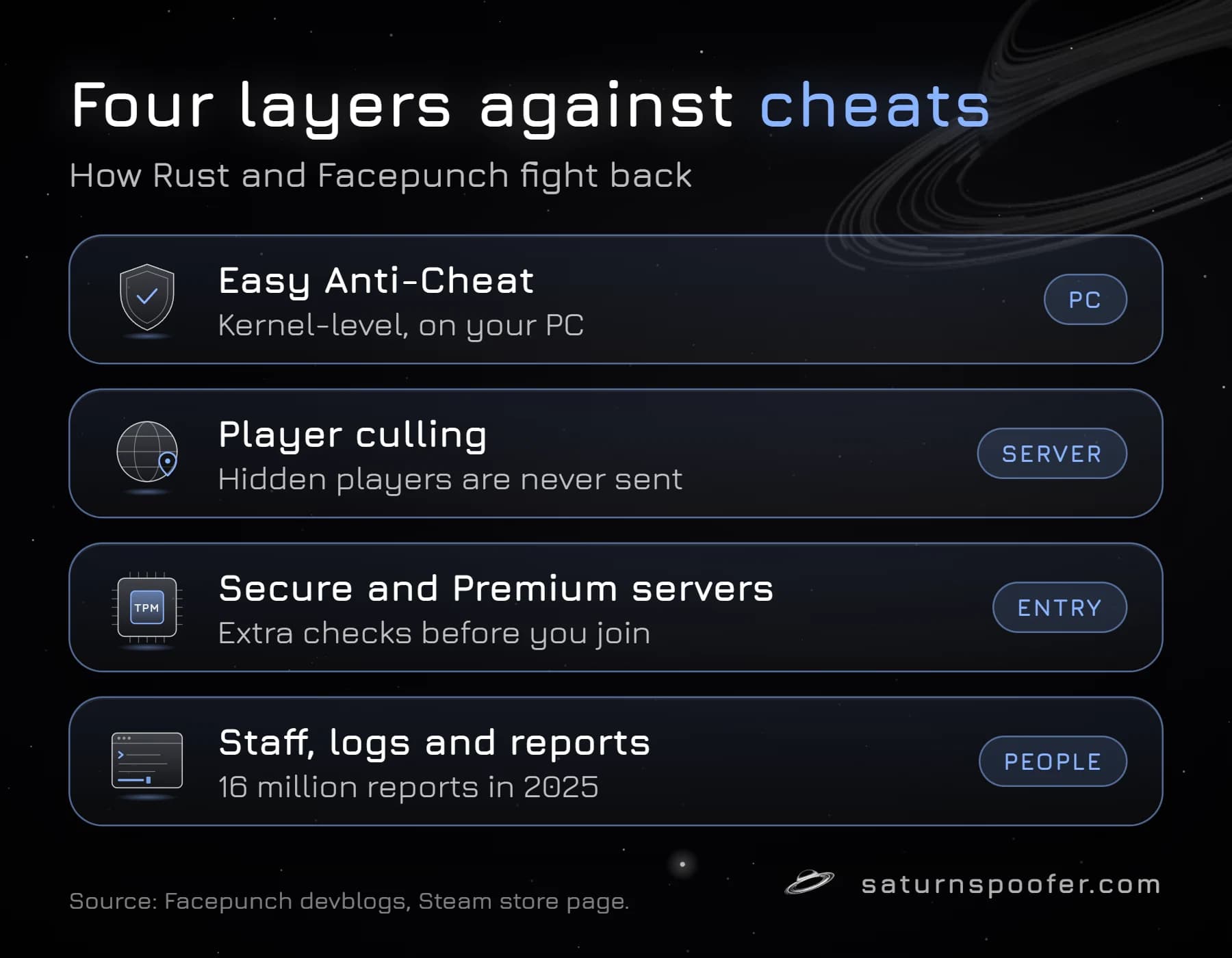
Rust uses Easy Anti-Cheat, Epic's kernel-level anti-cheat, on your PC. Since 2025, Facepunch has added server-side player culling, Secure and Premium servers, and staff who review reports and logs.
Steam's store page lists Rust under "Uses Kernel Level Anti-Cheat," names Easy Anti-Cheat, and notes it needs manual removal after you uninstall the game.
Easy Anti-Cheat on Your PC
Easy Anti-Cheat is the layer behind the "EAC Banned" message. Facepunch's support page says the message means your Steam account has been game banned through Easy Anti-Cheat for a cheating-related violation, and it can no longer play Rust on EAC-secured servers.
The driver looks for cheat software and for anything tampering with the game's memory or files, which is how Easy Anti-Cheat works in every game that runs it. Its Rust bans can also land on a delay: Facepunch says an EAC ban may take effect hours or days after the activity that triggered it, and you don't need to be online when it lands.
On Facepunch's Servers
On Facepunch's side, the strategy is to stop sending cheats the data they need. Player culling hides fully obscured players from your client, and the 2024 network changes stopped sending health, stash locations and tool cupboard lists.
This is the layer I'd take most seriously, because it doesn't need to find the cheat at all. A cheat that reads memory can only show what the server sent.
Secure and Premium Servers
Secure and Premium servers both exist to keep cheat accounts out: Secure servers require TPM 2.0 and Secure Boot before you can join, and Premium servers require a Rust Steam inventory above a minimum value Facepunch sets.
Facepunch launched Secure servers in March 2026 on 6 of its own servers and added 6 more in October 2026. Its stated end goal is to make the requirement global, but in April 2026 only about 60% of players had TPM and Secure Boot both turned on.
Premium servers came first, in March 2025, as what Facepunch called "an extra layer of friction against disposable cheat accounts."
Staff, Logs and Reports
Facepunch's staff watch cheaters directly, and the logs give them a lot to watch. In February 2026, Facepunch's COO wrote on X that "every gun shot, every message, every dropped item, every kind of interaction is logged, recorded and can be played back or watched live."
Players feed that system with reports, more than 16 million of them in 2025.
A cheat has to beat the driver, the server and the people watching the logs, and it has to keep beating all three every wipe for as long as the account exists.
Is There a Cheating Problem in Rust?
Yes. Facepunch's own figures, published in April 2026, found about 1 cheater in every 42 players on a regular server, and about 1 in 63 on its new Secure servers.
Facepunch flagged the limit itself: the Secure figure came from a small pool of 6 servers. Its 2025 anti-cheat numbers, published on January 1, 2026, show the scale behind it:
- More than 338,000 bans in total in 2025.
- More than 296,000 of them permanent, up 27% on the year before.
- More than 42,000 temporary bans, which Facepunch doesn't break down by reason.
- More than 16 million cheat reports, up 28%.
So my answer has two halves: Rust has a lot of cheaters, and the ban count keeps climbing because Facepunch keeps catching them.
What a Cheating Ban Costs You in Rust
A cheating ban in Rust costs your Steam account every EAC-secured server, and it can reach your next account, the people you play with and, on a second offense, your PC.
Facepunch's rules stack like this, from its EAC Banned article and its other support pages:
- The account. EAC bans "are permanent unless overturned through the appropriate review process," and the ban shows as a Game Ban status on your Steam profile.
- Your items. The ban "may affect your ability to access certain Rust features or transfer associated in-game items," and you can't move the game to another account.
- Your next account. Playing on a second Steam account while banned is ban evasion, and Facepunch says those accounts can face permanent game bans too.
- Your teammates. Facepunch bans players it finds, beyond a reasonable doubt, playing with cheaters. Staff place those bans by hand, they're permanent, and appeals to support are rejected automatically.
- A borrowed copy. Steam Family Sharing has been disabled for Rust since February 17, 2021, so every player needs their own copy.
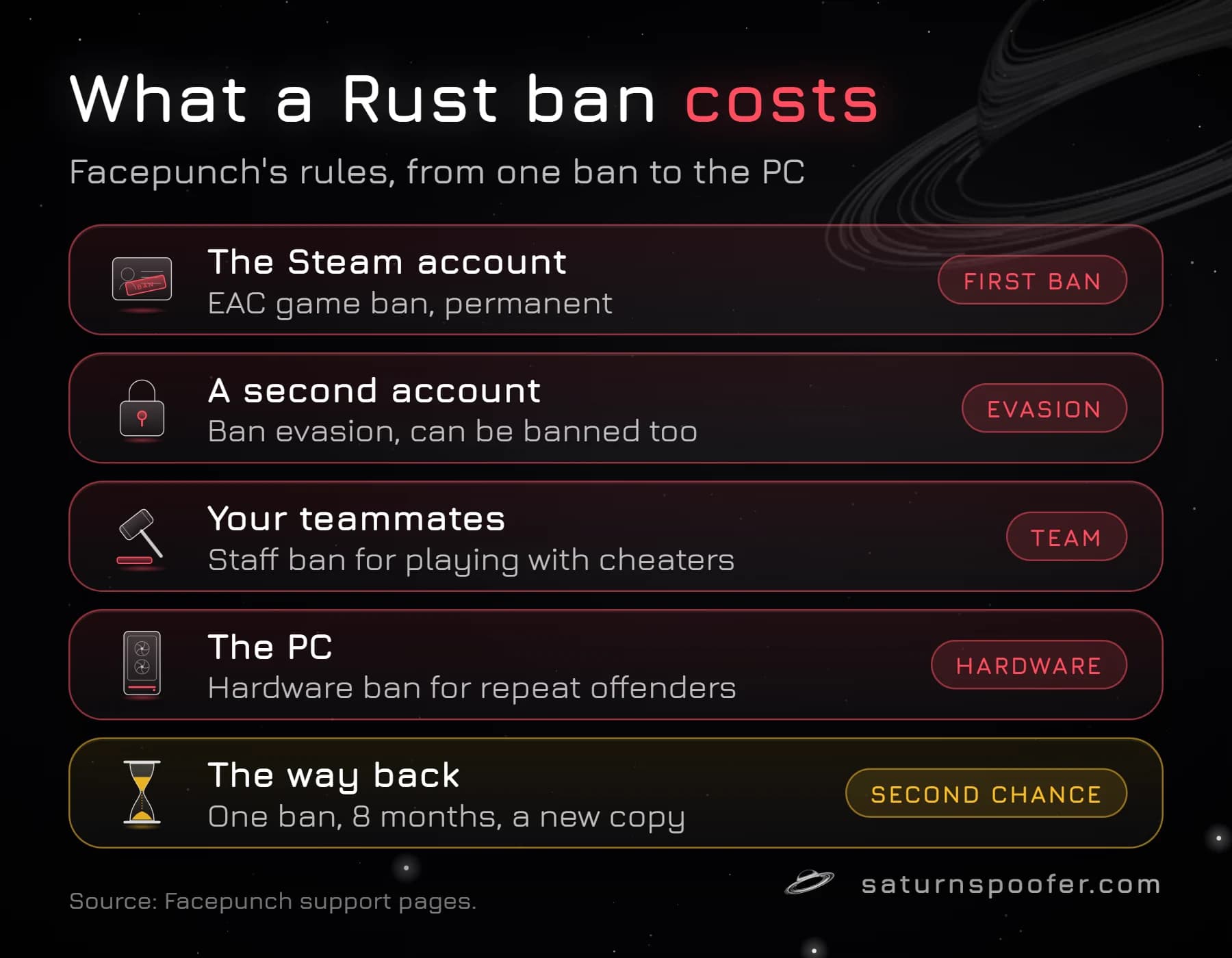
The cost I'd underline isn't on that list: the PC. A Rust HWID ban goes only to repeat offenders, according to Facepunch, and it's the one Rust ban tied to the computer rather than the Steam account.
There's one way back, and it isn't an unban. Facepunch's Ban Second Chances policy lets a player with a single ban, more than 8 months old and with no reoffending or ban evasion, buy Rust again on a new account. If you have one old ban, I'd take that route over anything else. Repeat cheaters and hardware-banned players are excluded, and a second offense after returning means "No appeals. No more chances."
If you didn't cheat and think the detection was wrong, the route is a Rust ban appeal through Easy Anti-Cheat, not Facepunch's ticket desk, because Facepunch says its support team can't overturn EAC bans or speed up the review. A hacked account doesn't change the outcome either: Facepunch says a stolen account used to cheat isn't exempt.
One detection, and the account goes. Get caught again, and the PC goes with it.
Are Free Rust Cheats Safe?
No. Free Rust cheats get the account banned like paid ones do, and free cheats are one of the most common ways gamers end up with infostealer malware.
Flare, a threat exposure management firm, looked at 53,896 devices infected with infostealers between June and August 2025. In its November 25, 2025 report, 41% of infections came from a gaming-related file, and cheats, mod menus, aimbots and skin changers made up over half of those.
An infostealer goes after saved passwords, browser sessions and game logins, and that creates a second problem in Rust. If someone uses your stolen Steam login to cheat, Facepunch's policy says the account still takes the ban.
I'd treat any free download promising Rust hacks as malware until proven otherwise. The file can cost you more than the account does.
What to Do About Cheaters on Your Server
When a cheater kills you in Rust, report them in-game straight away, then think about which servers you play on.
Facepunch's reporting guide says F7 opens the report panel, and you can also report from the death screen, a player's contact card or server chat. It asks you to report "the moment you encounter them," because that captures the information Facepunch and Easy Anti-Cheat need, and many community servers read those reports as well.
The second step matters as much: Facepunch's own numbers say Secure servers had fewer cheaters than regular ones, and it calls Premium servers the best cheat-free experience it offers. If you have TPM 2.0 and Secure Boot turned on, a server with the Secure tag in the browser is the first place I'd try.
I'd report every one, even when the raid is already lost. Then move servers if you have to. Don't team up with someone you suspect, because playing with cheaters is a ban reason of its own.
Where an HWID Spoofer Fits (and Where It Doesn't)
An HWID spoofer fits one situation in Rust: Facepunch has banned the PC itself, and you want that PC to play again.
That's the one case we build Saturn for. We don't make cheats. That's what an HWID spoofer changes: the hardware IDs your PC reports, such as the CPU, TPM, motherboard, disks, GPU, monitor and network adapter values, so a hardware-banned machine shows up as different hardware.
No cheat cover. No account unban. No protection for an account that keeps cheating, because the cheat gets caught exactly as it was the first time.
Saturn is the wrong answer if:
- You have one EAC ban on one account. That's an account ban, and the 8-month route is the one Facepunch offers.
- A community server banned you. That ban belongs to the server owner, not your hardware.
- You were banned for playing with a cheater. That's a staff ban on the account.
- You think the detection was a mistake. Appeal first.
- You expect it to keep a cheating account alive. The next detection bans the next account.
Better you read that here than find it out after paying.
Where it does fit, Saturn covers Rust under its Easy Anti-Cheat license, and the HWID spoofer for Rust runs from the same single loader as every other Saturn license, with your license deciding which games it covers.
As of November 9, 2026, Saturn is currently undetected by every anti-cheat it supports, and the live status page is where that's tracked day to day. I'd keep one thing straight, though: that's Saturn's own footprint, not your cheat's, and an anti-cheat that catches the cheat still bans the account.
Temporary mode gives you unlimited profiles, and your original IDs come back when you close it, while Permanent mode writes one profile for good.
Where it falls short: Facepunch treats a new account used to get around a ban as ban evasion, and a spoofer doesn't change that rule. The ban on your old account stays, and so does the Game Ban on that Steam profile.
Every license comes with a 24-hour free trial, no card needed, only an email address for the key.
Rust Cheats FAQ
Do you get banned for scripting in Rust?
Yes. Facepunch counts recoil scripts as cheating, and Easy Anti-Cheat has worked on detecting them since mid-2025. As the November 2026 wipe began, Facepunch said it was rolling out bans to more than 3,000 accounts that used public and private script providers.
Does Rust use Easy Anti-Cheat?
Yes. Rust uses Easy Anti-Cheat, Epic's kernel-level anti-cheat, and Steam also lists it as Valve Anti-Cheat enabled. Facepunch adds server-side player culling, Secure servers that require TPM 2.0 and Secure Boot, Premium servers, and staff who review reports and logs.
Do Secure servers in Rust have fewer cheaters?
Yes, by Facepunch's own count. In figures published in April 2026, it found about 1 cheater in 63 players on its Secure servers, which require TPM 2.0 and Secure Boot, against about 1 in 42 on regular servers. Facepunch noted the Secure sample was small, 6 servers at the time.
Can you get banned for playing with a cheater in Rust?
Yes. Facepunch bans players it finds, beyond a reasonable doubt, playing with cheaters. Staff place those bans by hand, they don't expire, and appeals to support are rejected automatically.
Do Rust cheaters get hardware banned?
Repeat offenders do. Facepunch says hardware bans are only issued to players banned more than once, and a hardware-banned player can't use the 8-month second chance.
Does an HWID spoofer hide Rust cheats?
No. An HWID spoofer changes the hardware IDs a PC reports and does nothing to hide cheat software from Easy Anti-Cheat or Facepunch's staff. A cheating account gets caught whether a spoofer is running or not.
Final Thoughts
Rust cheats come in five types, from aimbots and ESP to recoil scripts and DMA cards, and Facepunch now fights them on the PC, on the server and in the logs.
My advice is short. If you're thinking about running one, I've read Facepunch's own pages, and they say the account goes on the first detection and the PC can follow on the second. If a cheater wiped your base, report them with F7 and give a Secure server a try.
Checked by Gabri on November 9, 2026. Sources: Facepunch devblogs Surviving 12 Years (January 1, 2026), Shipshape (March 5, 2026), Spring Clean (April 2, 2026), Livestock (October 1, 2026) and Printed and Polished (November 5, 2026), plus Facepunch's Steam announcements of July 4, 2024, January 2, 2025, February 6, 2025, March 6 and 13, 2025 and June 5, 2025; Facepunch support articles EAC Banned, Ban Second Chances, Banned for Playing With Cheaters, Reporting in Rust, Guidelines for Community Servers, Premium Servers and Steam Family Share Disabled; Rust's Steam store page; PC Gamer (February 7, 2026) for the COO's post on X; Flare (November 25, 2025). UNVERIFIED: whether the third-party anti-cheat layer Facepunch announced for 2026 has shipped.